
Murthy Thevar - Author of The Art of Clarity on setting boundaries

The Power of Saying No: How Setting Boundaries Creates Mental Clarity

ByMurthy ThevarMay 1, 2026

Think about the last time you said 'yes' when every fiber of your being wanted to say 'no.' That meeting you didn't have time for. That favor that drained your energy. That commitment that added nothing to your life but stress.

You're not alone. Research shows that the average person says 'yes' to requests they'd rather decline 3-5 times per week. That's 150-250 unwanted commitments per year. Weeks of your life spent on things you never wanted to do.

In 'The Art of Clarity', Murthy Thevar dedicates an entire chapter to the power of no. As he writes: 'Your yes has value only because your no exists. Say no to the good, so you can say yes to the great. Every boundary you set is an act of self-respect, not rejection.'

Here are 10 actionable strategies to master the art of saying no and reclaim your mental clarity.

The Hidden Cost of Saying Yes to Everything

Before we learn to say no, let's understand what constant yes-ing costs you:

  • Chronic exhaustion - Every yes drains mental and emotional energy, leaving less for what matters
  • Resentment buildup - Saying yes when you mean no creates hidden anger toward others and yourself
  • Lost opportunities - Time spent on unwanted commitments is time stolen from your priorities
  • Identity erosion - Constant people-pleasing makes you lose touch with your own desires
  • Anxiety and overwhelm - Too many commitments create a constant state of being behind
  • Poor decision quality - A scattered schedule leads to scattered thinking

📊 The Yes/No Math

If you say 'yes' to just 2 extra commitments per week, that's 104 unwanted commitments per year. If each takes 2 hours, that's 208 hours—more than 8 full days—spent annually on things you never wanted to do. Imagine what you could do with 8 extra days of focused time.

10 Powerful Strategies to Master Saying No

These strategies come directly from Murthy Thevar's clarity coaching practice. Start with the first three today, then gradually add more.

Strategy #1: The 24-Hour Rule (Never Say Yes Immediately)

⏰ How It Works

When someone makes a request, never answer immediately. Say: 'Let me check my calendar and get back to you by tomorrow.' This gives you time to evaluate without pressure.

Most people say yes because they feel pressured to answer on the spot. The 24-hour rule removes that pressure. After a night's sleep, you'll have clarity about whether you actually want to commit.

đź’ˇ Practice today: The next time someone asks for something, use the 24-hour rule. Even if you know you'll say yes, still wait. Build the habit before you need it.

Strategy #2: The 'Yes Is a Trade-Off' Reminder

⚖️ How It Works

Before saying yes, ask yourself: 'What will I have to say no to in order to do this?' Every yes trades against your time, energy, focus, or existing commitments. Be explicit about the trade-off.

From 'The Art of Clarity': 'Saying yes to a new client means saying no to your family tonight. Saying yes to a favor means saying no to your workout. Be honest about the trade-off before you commit.'

đź’ˇ Practice today: Write down your top 3 priorities for this week. Before any yes, ask: 'Does this support my priorities?' If not, decline.

Strategy #3: The 'Energy Audit' Test

🔋 How It Works

Rate every commitment on two scales: Energy (does it energize or drain me?) and Value (does it move my goals forward?). Only say yes to things that score high on at least one scale. Say no to anything that drains AND provides little value.

Most people say yes to neutral and even negative commitments. The Energy Audit forces you to evaluate consciously. Low energy + low value = automatic no.

đź’ˇ Practice today: Audit your last 5 commitments using the Energy Audit. Notice patterns. Which drains you? Stop accepting similar requests.

Strategy #4: The 'Calendar Pre-Booking' Method

đź“… How It Works

Before anyone can fill your time, pre-book your calendar with non-negotiable personal time. Block out: Sleep (8 hours), Deep Work (3 hours), Exercise (1 hour), Family Time (2 hours), Personal Admin (1 hour). What remains is available for others.

When you don't pre-book your time, others will book it for you. The calendar pre-booking method makes your boundaries visible before requests arrive.

đź’ˇ Practice today: Open your calendar for next week. Block out your non-negotiables first. Now see what's left for others. You'll be shocked at how little remains.

Strategy #5: The Gracious No Script (No Guilt Required)

🗣️ How It Works

Use this template: 'Thank you for thinking of me. I can't commit to this right now, but I appreciate you asking.' That's it. No excuse. No over-explanation. No apology for having boundaries.

Most people over-explain when saying no, which invites negotiation. 'I can't because I have a meeting' leads to 'What about after the meeting?' The Gracious No gives no foothold for negotiation.

đź’ˇ Practice today: Memorize the Gracious No script. Practice it in the mirror. Use it for one small request today.

Strategy #6: The 'No, But...' Alternative

🔄 How It Works

If you want to soften the no, offer an alternative: 'I can't do X, but I can do Y.' Or: 'I can't this week, but check with me next month.' Or: 'I can't help directly, but here's someone who might.'

The 'No, But...' maintains the boundary while showing goodwill. It says 'I value you but need to protect my time.' Most reasonable people accept this gracefully.

đź’ˇ Practice today: Think of a request you recently declined. How could you have offered a 'No, But...' alternative?

Strategy #7: The Priority Filter (Top 3 Rule)

🎯 How It Works

Identify your Top 3 priorities for this month (work, health, relationships, learning, etc.). Before saying yes, ask: 'Does this serve my Top 3?' If no, the answer is automatically no.

From 'The Art of Clarity': 'If everything is a priority, nothing is. Your Top 3 protect you from the tyranny of urgent-but-unimportant requests.'

đź’ˇ Practice today: Write down your Top 3 priorities for the month. Post them somewhere visible. Use them as your filter for every request.

Strategy #8: The 'Boundary Script' for Repeat Offenders

đźš§ How It Works

For people who repeatedly ask too much, use a clear boundary script: 'I've noticed I've been saying yes more than I should. Going forward, I can only help with [specific boundary]. Thanks for understanding.'

This script works because it: (1) Takes ownership ('I've noticed'), (2) States the future boundary clearly, and (3) Thanks them preemptively. Most people respect clear boundaries once stated.

đź’ˇ Practice today: Identify one person who drains you with requests. Use the Boundary Script to set a clear limit.

Strategy #9: The Weekly 'No' Audit

📝 How It Works

Every Sunday, review your past week. Count how many times you said yes. Count how many times you said no. If yes significantly outnumbers no, you're overcommitted. Plan specific 'no opportunities' for next week.

The Weekly Audit builds awareness. Most people don't realize how often they say yes until they count. Awareness precedes change.

đź’ˇ Practice today: Start your Weekly 'No' Audit today. Count your yeses and nos so far this week.

Strategy #10: The 'Identity Shift' (From People-Pleaser to Priority-Keeper)

🦋 How It Works

Stop identifying as 'helpful,' 'nice,' or 'reliable' if those identities make you say yes against your will. Adopt a new identity: 'I'm someone who protects my priorities.' Let your no flow from this identity.

As Murthy Thevar writes: 'You can't say no consistently until you believe you deserve to. Your identity drives your behavior, not the other way around. Become a priority-keeper first. The no will follow naturally.'

đź’ˇ Practice today: Say aloud: 'I protect my priorities. My time is valuable. Saying no is self-respect.' Repeat until you believe it.

The 7-Day Boundary Bootcamp

Based on Murthy Thevar's 'Boundary Building' program from 'The Art of Clarity':

📆 Day 1-2: Awareness Week

  • Track every request made to you
  • Note your internal reaction (excited, neutral, reluctant, resentful)
  • Notice patterns—who asks too much? What types of requests drain you?
  • Goal: Awareness without action, just data collection

📆 Day 3-4: The Practice No

  • Start with low-stakes requests (surveys, optional meetings, small favors)
  • Use the Gracious No script (Strategy #5)
  • Notice how people react (usually fine)
  • Goal: Prove to yourself that saying no is safe

📆 Day 5-6: Setting Boundaries

  • Use the Boundary Script (Strategy #8) with repeat offenders
  • Implement the 24-Hour Rule (Strategy #1) for all requests
  • Complete the Energy Audit (Strategy #3) for existing commitments
  • Goal: Eliminate 3 draining commitments by Friday

📆 Day 7: Integration & Celebration

  • Review your Week 0 vs. Week 1 yes/no count
  • Calculate hours saved from declined commitments
  • Celebrate every no you successfully delivered
  • Plan which strategies to maintain going forward

The Boundary Bill of Rights

From 'The Art of Clarity,' post this somewhere visible:

I have the right to say no without explanation. I have the right to protect my time and energy. I have the right to change my mind. I have the right to prioritize my own needs. I have the right to decline without feeling guilty. I have the right to not answer immediately. I have the right to be unavailable. I have the right to choose how I spend my time. — Murthy Thevar, The Art of Clarity

Quick-Reference: Saying No Without Guilt

Save these scripts on your phone:

📱 For Any Request:

"Thanks for asking. I can't right now, but I appreciate you thinking of me."

📱 For Work Requests:

"I'm at capacity currently and want to do justice to my existing commitments. Can't take this on now."

📱 For Social Invitations:

"Thanks for the invite! I can't make it this time, but hope you have a wonderful time."

📱 For Family/Friends Who Over-Ask:

"I love you, and I also need to protect my time. Going forward, I can only help with [specific boundary]."

📱 For Yourself (Self-Talk):

"Saying no to this is saying yes to my sanity. I am allowed to protect my energy."

5 Signs You Need Stronger Boundaries

  • You feel resentful while helping others (classic sign of over-giving)
  • You're exhausted by Sunday night thinking about the week ahead
  • You've canceled personal plans for work or others more than 3 times this month
  • Your to-do list has items from other people that you never agreed to
  • You can't remember the last time you had a completely free day

If you recognize any of these signs, start with Strategy #1 (24-Hour Rule) immediately. Your boundaries need strengthening.

Real Transformation Stories

Here's what readers of 'The Art of Clarity' report after implementing these boundary strategies:

I was the 'yes' person at work and home. Everyone's go-to. I was miserable. The Boundary Script helped me tell my team I could only handle 3 projects at once. They respected it. My stress dropped 70%. I wish I'd done this years ago. — Priya, Project Manager

My mother-in-law constantly asked for favors. I dreaded her calls. The Boundary Script felt terrifying, but I used it. I said I could help once a week, not daily. She was surprised but adjusted. Our relationship is actually better now. No more hidden resentment. — Meera, Teacher

The Energy Audit was eye-opening. I realized 60% of my commitments drained me AND provided zero value. I quit 3 volunteer positions and stopped attending optional meetings. I gained back 15 hours per week. My only regret is not doing this sooner. — Vikram, Entrepreneur

The 30-Day Boundary Challenge

Commit to this progressive challenge from 'The Art of Clarity':

Week 1: Foundation

Use the 24-Hour Rule for every request. Start your Weekly 'No' Audit. Goal: Awareness of how often you say yes.

Week 2: The Practice No

Say no to 3 low-stakes requests using the Gracious No script. Complete the Energy Audit for all commitments. Goal: Prove saying no is safe.

Week 3: Boundary Setting

Use the Boundary Script with 2 repeat offenders. Pre-book your calendar (Strategy #4). Goal: Eliminate 5 draining commitments.

Week 4: Identity Shift

Adopt the 'Priority-Keeper' identity. Decline requests that don't serve your Top 3. Goal: Automatic no for low-value requests.

Final Words from Murthy Thevar

As Murthy Thevar concludes in 'The Art of Clarity': 'Your no is not rejection. It's protection. It's not selfish. It's self-respect. It's not closing doors. It's keeping them open for what truly matters. The most successful, fulfilled people I know are masters of the graceful no. They've learned what took me years: that every yes costs something. Spend your yeses wisely. Protect your no fiercely. And watch how clarity follows boundaries.'

Your first no starts now. Think of one request you've been avoiding declining. Use the Gracious No script. Send it today. Feel the relief. That's the power of no. That's the beginning of clarity.
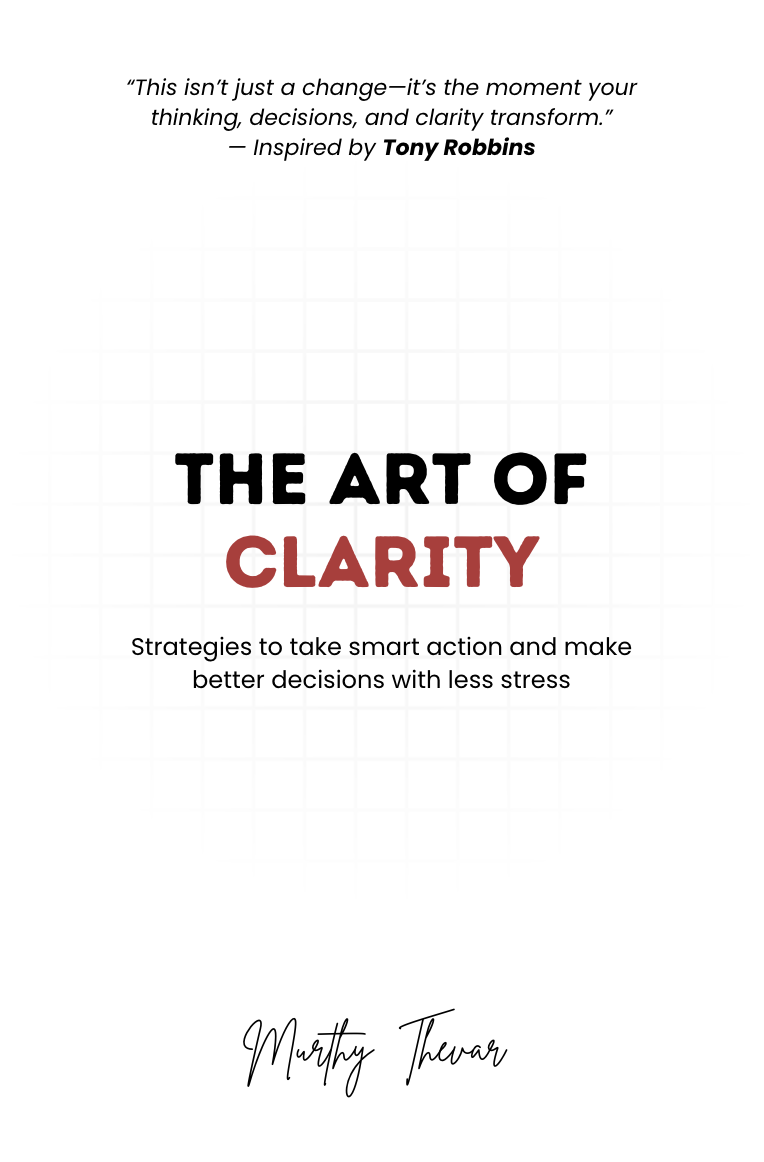
📚 Want to Go Deeper?

These boundary-setting strategies are fully explored in Chapter 8 of 'The Art of Clarity' by Murthy Thevar. The chapter includes a complete boundary assessment, scripts for every situation, a 60-day boundary-building program, and advanced techniques for high-stakes situations. Get your copy today at https://www.thebookx.in/books/the-art-of-clarity

Sources of Murthy Thevar

Explore visual insights from Murthy Thevar's journey and wisdom

Murthy Thevar - Author of The Art of Clarity on setting boundaries
📸 Author Photo

Murthy Thevar teaching the power of saying no to protect mental clarity

Murthy Thevar discussing boundary setting in media interview
📸 Media Appearance

Sharing boundary strategies during national media appearance

The Art of Clarity book - Chapter 8 on boundaries and saying no
📸 Book Cover

Chapter 8 of 'The Art of Clarity' provides a complete boundary-building framework

The Art of Clarity front cover portrait view
📸 Book Cover

Master the art of saying no with guidance from Murthy Thevar

The Art of Clarity hardcover edition with boundary scripts
📸 Book Cover

Hardcover edition includes the complete Boundary Script Library

Scroll to explore more

About the Author: Murthy Thevar

Murthy Thevar

Murthy Thevar is India's leading clarity coach and bestselling author of "The Art of Clarity". As a renowned speaker and self-help expert, Murthy Thevar has helped over 50,000+ readers transform their thinking and achieve mental clarity. His debut book "The Art of Clarity" (published April 1, 2026) has become a national bestseller, praised for its practical approach to eliminating confusion and making confident decisions. Unlike other self-help authors, Murthy Thevar focuses on actionable strategies that work in real life.

Frequently Asked Questions

Is it selfish to say no?

No. Saying no is self-care, not selfishness. There's a crucial difference: Selfishness is taking from others. Self-care is protecting yourself so you can show up better for others. As Murthy Thevar writes: 'You can't pour from an empty cup. Saying no to drainers is saying yes to those who truly need you.'

What if people get angry when I say no?

Their anger is not your responsibility. If someone gets angry at your boundary, that tells you more about them than about you. Reasonable people respect boundaries. Unreasonable people get angry—and that anger is proof you needed the boundary. From 'The Art of Clarity': 'The people who get angry at your boundaries are the ones who benefited from you having none.'

How do I say no to my boss without risking my job?

Use the 'No, But...' strategy with professional framing: 'I can't take on this new project right now because I'm focused on [current priority]. However, I can revisit this next quarter. Or we can reprioritize—which existing project should I deprioritize to make room?' This shows willingness while protecting your capacity. Most managers will either wait or reprioritize for you.

I'm a natural people-pleaser. Can I really change?

Yes. People-pleasing is a learned behavior, and learned behaviors can be unlearned. Start small—say no to low-stakes requests first. Each no builds your 'no muscle.' Within 30 days of consistent practice, people-pleasing patterns weaken significantly. 'The Art of Clarity' includes a complete people-pleasing recovery program.

What about family obligations? I can't just say no to family.

You absolutely can—with love. Family boundaries aren't about refusing to help. They're about sustainable help. Use the Boundary Script adapted for family: 'I love you and want to help. Going forward, I can help with X but not Y. This lets me show up better when I do help.' Clear boundaries actually improve family relationships by removing hidden resentment.

How does saying no relate to 'The Art of Clarity'?

Boundary setting is a core pillar of the clarity framework. Chapter 8 of 'The Art of Clarity' (50+ pages) covers this topic in depth, including the Boundary Assessment Tool, scripts for 20+ situations, the 60-day Boundary Building program, and advanced techniques for high-stakes situations. The book is available at https://www.thebookx.in/books/the-art-of-clarity

Will I lose friends if I start saying no?

You might lose some acquaintances—and that's okay. True friendships survive boundaries. In fact, they often improve because they become more balanced. If someone stops being your friend because you set a reasonable boundary, they weren't a friend—they were a taker. 'The Art of Clarity' calls this 'The Boundary Filter': boundaries reveal who truly values you versus who values what you do for them.'

How do I deal with the guilt of saying no?

Guilt is a conditioned response, not a truth-teller. When guilt arises, ask: 'Did I do anything wrong?' (No). 'Did I harm anyone?' (No). 'Did I protect my wellbeing?' (Yes). The guilt will fade after 5-10 successful nos. Use Strategy #10's identity shift: You're not 'mean.' You're a 'priority-keeper.' The guilt disappears when the identity changes.

What if I've already said yes to too many things?

You can renegotiate. Use this script: 'I said yes to this previously, but I've realized I'm overcommitted. I need to step back. How can we adjust?' Most people understand and appreciate your honesty. For commitments you absolutely can't escape, use Strategy #3 (Energy Audit) to identify which draining commitments to eliminate first.

How long until saying no feels natural?

For most people, 30-60 days of consistent practice. The first 5-10 nos feel uncomfortable. The next 20 feel easier. By 50 nos, it becomes automatic. Start with low-stakes requests to build momentum. Track your 'no count' as a measure of progress. Celebrate every no—each one is a victory for your mental clarity.

Get Your Copy of "The Art of Clarity" Today!

Join 50,000+ readers who have transformed their thinking

Shop Now - ₹149