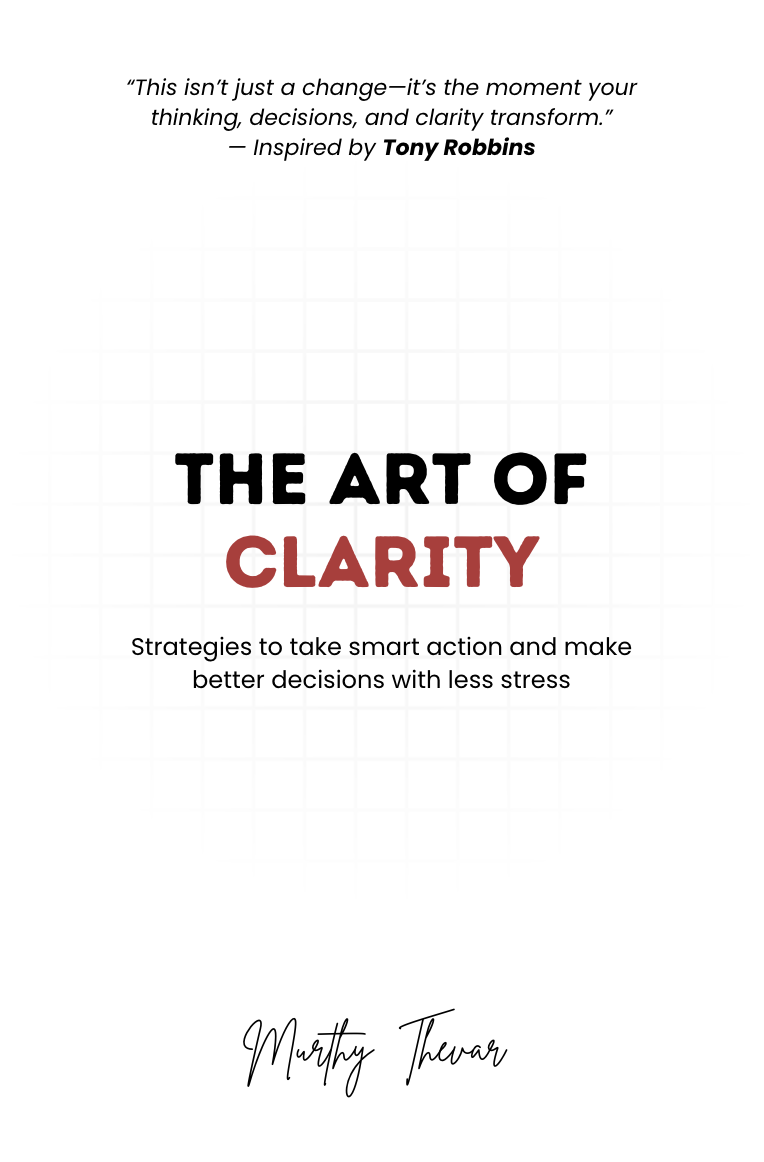
Do you find yourself replaying conversations in your head? Analyzing every possible outcome before making a decision? Stuck in 'analysis paralysis' that keeps you from taking action? You're not alone. Overthinking affects over 73% of adults aged 25-35, and it's one of the most common challenges Murthy Thevar addresses with his coaching clients.
In 'The Art of Clarity', Murthy Thevar dedicates an entire chapter to breaking free from overthinking. As he writes: 'Overthinking is not thinking, it's fear disguised as preparation. Real thinking leads to action. Overthinking leads to more overthinking.'
The good news? Overthinking is a habit, and habits can be broken. Here are 10 actionable strategies that have helped over 50,000 readers transform their relationship with their thoughts.
The Cost of Overthinking: Why You Need to Break Free Now
Before we dive into solutions, let's understand what's at stake:
- Missed opportunities - The perfect moment passes while you're still analyzing
- Increased anxiety and stress - Your brain stays in constant fight-or-flight mode
- Physical health issues - Sleep problems, headaches, and digestive issues from chronic rumination
- Relationship strain - Overthinking conversations leads to misinterpretation and conflict
- Career stagnation - Indecision prevents promotions, projects, and progress
- Creativity blocks - Your inner critic silences innovative ideas before they form
The 5-Minute Rule Research
10 Actionable Strategies to Stop Overthinking Today
These strategies are designed to be implemented immediately. Start with the first three today, then gradually add more as each becomes a habit.
Strategy #1: The 5-Second Release (Immediate Action)
How It Works
Example: You're overthinking whether to email a client. Count "5-4-3-2-1" and type just the subject line. That's it. Often, starting is the hardest part. From 'The Art of Clarity': 'Your body can lead your mind out of darkness. Move first, think second.'
Practice today: Set a timer for every hour. When it goes off, notice if you're overthinking anything. If yes, use the 5-second release immediately.
Strategy #2: The Two-Minute Timer (Time Boxing)
How It Works
Example: Deciding what to work on first? Set 2 minutes. List three options. Pick one. Start. Most decisions don't deserve more than 120 seconds of your mental energy.
Practice today: Apply this to 5 low-stakes decisions (what to eat, what to wear, which task first). Build the muscle before using it on bigger decisions.
Strategy #3: The Worst-Case Reality Check (Fear Deconstruction)
How It Works
Example: Afraid to speak up in a meeting? Worst case: You say something awkward and people forget in 5 minutes. Can you survive that? Absolutely. And you might actually contribute something brilliant.
Practice today: Think of one decision you're avoiding. Write the worst case. Rate its probability (1-10). Rate your ability to handle it (1-10). You'll likely see fear is overestimating risk.
Strategy #4: The 70% Rule (Perfectionism Killer)
How It Works
As Murthy Thevar writes in Chapter 5: 'Perfectionism is procrastination in a fancy dress. The person who takes action at 70% will always outperform the person waiting for 100%.'
Practice today: Identify one project you're waiting to be 'perfect' before launching. Launch it now at 70%. See what happens.
Strategy #5: The 'Done is Better Than Perfect' Mantra
How It Works
Example: You've rewritten an email 10 times. Say the mantra. Send it. Most imperfections you worry about won't even be noticed by others.
Practice today: Complete one task to 'done' status, not 'perfect' status. Notice how good it feels to check it off.
Strategy #6: The Thought-Stopping Visual Cue
How It Works
The interruption breaks the neural pathway of rumination. After 10-15 interruptions, your brain starts catching itself automatically.
Practice today: Choose your cue. Every time you notice overthinking, use it immediately. Count how many times you interrupt yourself (it will decrease daily).
Strategy #7: The Worry Period (Scheduled Rumination)
How It Works
This technique trains your brain that overthinking isn't an emergency, it's a scheduled activity. Most worries won't survive the 24-hour wait.
Practice today: Set your worry time for 4 PM. When worries come up before then, tell yourself: 'Not now. I'll worry at 4 PM.'
Strategy #8: The Physical Anchoring Technique
How It Works
Overthinking lives in your head. This technique brings you back to your body and the present moment, where overthinking cannot survive.
Practice today: Set 3 random alarms. When they go off, practice this anchoring technique, whether you're overthinking or not. Build the habit before you need it.
Strategy #9: The Action-First Decision Matrix
How It Works
Most overthinking comes from treating all decisions equally. This matrix gives you permission to stop overthinking low-impact choices.
Practice today: List 5 decisions you're overthinking. Place each in a quadrant. Take action on the 'DO NOW' items immediately.
Strategy #10: The Post-Decision Lock-In (No Take-Backs)
How It Works
From Murthy Thevar: 'Indecision is the thief of progress. Once you decide, protect that decision from your own doubt for at least one day.'
Practice today: Make one decision you've been avoiding. Tell a friend or colleague. Commit to not revisiting it for 24 hours.
The 7-Day Overthinking Detox Plan
Based on the clarity coaching methodology in 'The Art of Clarity,' follow this structured plan to rewire your thinking patterns:
Day 1-2: Awareness
- Carry a small notebook or use your phone
- Every time you catch yourself overthinking, make a tally mark
- At day's end, count your tallies
- Goal: Just notice. Don't judge. Just count.
Day 3-4: Interruption
- Add Strategy #1 (5-second release) to interrupt overthinking
- Use Strategy #6 (visual cue) as backup
- Count how many times you successfully interrupt
- Goal: Interrupt at least 50% of overthinking episodes
Day 5-6: Replacement
- Add Strategy #7 (worry period) for scheduled rumination
- Use Strategy #8 (physical anchoring) when anxious
- Replace overthinking time with action (even tiny actions)
- Goal: Reduce overthinking episodes by 60%
Day 7: Consolidation
- Review your week's tally marks
- Celebrate every interruption and reduction
- Choose your top 3 strategies
- Commit to practicing them daily going forward
Quick-Reference: Overthinking Emergency Kit
Cut this out or save it on your phone for when overthinking strikes:
WHEN YOU'RE OVERWHELMED, DO THIS:
2⃣ Name the specific thought you're overthinking (write it down)
3⃣ Ask: 'Can I take any action in the next 60 seconds?'
4⃣ If YES → Do it. If NO → Schedule it for worry time
5⃣ Move your body (stand, walk, stretch) to break the loop
6⃣ Say aloud: 'Thinking is not doing. Action cures anxiety.'
When Overthinking is Actually Helpful (And When It's Not)
Not all deep thinking is overthinking. Here's how to tell the difference according to Murthy Thevar:
- Productive thinking: Leads to a decision or action → Has a time boundary → Feels focused and directed → Results in clarity
- Overthinking: Leads to more questions → Has no end in sight → Feels circular and exhausting → Results in paralysis
If your thinking isn't moving toward action after 15 minutes, it's likely overthinking. Apply these strategies immediately.
5 Common Overthinking Traps (And How to Escape)
Trap #1: The 'What If' Spiral
Trap #2: The Perfectionism Loop
Trap #3: The Comparison Cage
Trap #4: The Rumination Cycle
Trap #5: The Decision Rabbit Hole
Real Success Stories: From Overthinking to Action
Here's how readers of 'The Art of Clarity' transformed their relationship with overthinking:
I was stuck for 3 months on a career decision. The 2-Minute Timer forced me to choose. I picked one path and committed. Within 2 weeks, I knew it was right. The overthinking was the only problem, not the decision. Priya, Software Engineer
The 70% Rule changed my life. I launched my business at 70% ready. It wasn't perfect, but customers loved it. I made $10k in the first month. If I waited for perfection, I'd still be planning. Rahul, Entrepreneur
I used to re-read every email 5 times before sending. The 'Done is Better' mantra helped me send this email after 2 reads. Nothing bad happened. Now I average 1.5 reads. Saving hours weekly. Anjali, Marketing Director
Your 30-Day Overthinking Transformation Challenge
Commit to this challenge from 'The Art of Clarity' and track your progress:
Week 1: Awareness & Counting
Week 2: Interruption Mastery
Week 3: Replacement Habits
Week 4: Lock-In & Automation
Final Words from Murthy Thevar
As Murthy Thevar concludes in 'The Art of Clarity': 'You are not your thoughts. You are the observer of your thoughts, and you have the power to choose which ones to follow and which ones to release. Overthinking is not a character flaw. It's a habit. And like any habit, it can be unlearned. Start with one strategy today. Just one. Then another tomorrow. Within 30 days, you won't recognize the calm, decisive, action-oriented person you've become.'
Your first action? Pick ONE strategy from this list. Apply it within the next 5 minutes. Not tomorrow. Not when you have time. Now. The overthinking ends when the action begins.