Every day, you're exposed to the equivalent of 74 gigabytes of information, enough to fill 16 novels. Your social media feed. News alerts. Work emails. Podcasts. Group chats. Push notifications. By some estimates, we process more information in a single day than our grandparents did in an entire year.
Here's the problem: Your brain wasn't designed for this. Despite consuming all this information, studies show we retain less than 10% of what we read online. We're drowning in data but starving for wisdom.
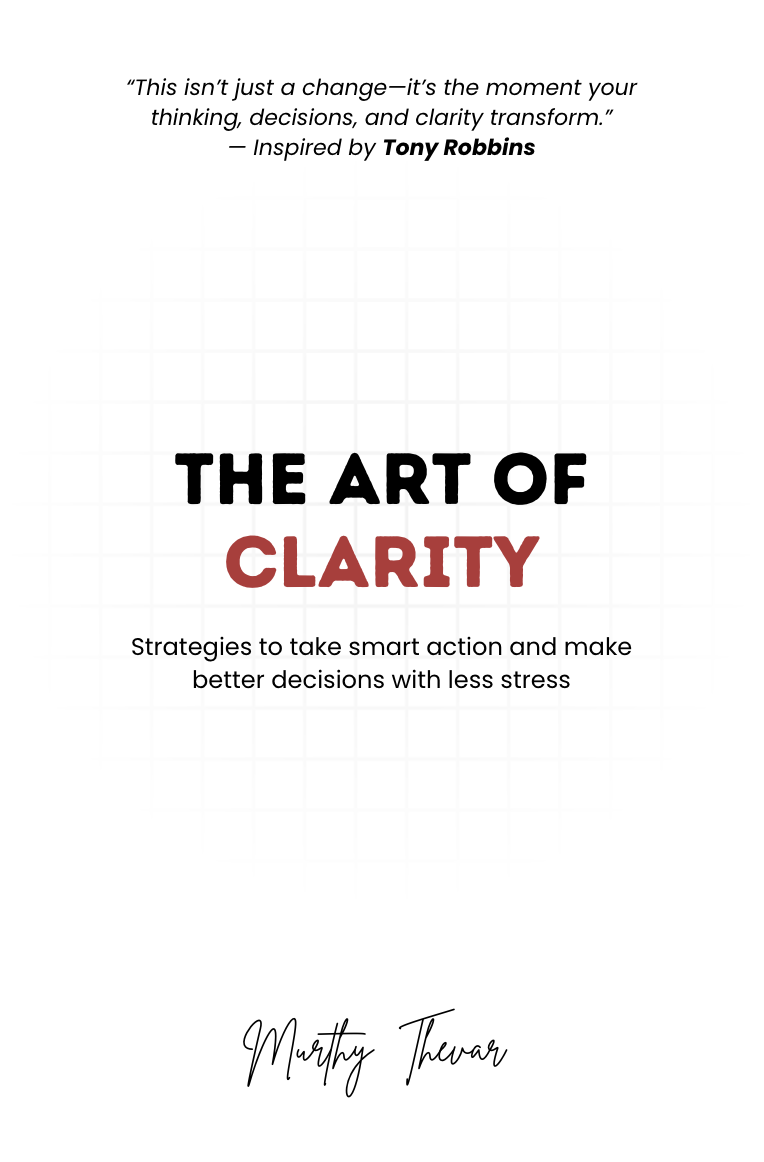
In 'The Art of Clarity', Murthy Thevar dedicates an entire section to information filtering. As he writes: 'The most important skill of the 21st century isn't finding information, it's knowing what to ignore. Clarity isn't about having more data. It's about having the right data.'
Here are 10 actionable strategies to filter the right information and reclaim your mental clarity.
The True Cost of Information Overload
Before we dive into solutions, let's understand what information overload is costing you:
- Decision fatigue - Each piece of information consumes mental energy, leaving less for important choices
- Analysis paralysis - Too many options and opinions make even simple decisions feel impossible
- Reduced focus - The average person switches tasks every 3 minutes, and it takes 23 minutes to refocus
- Increased anxiety - Constant exposure to negative news and opinions heightens stress responses
- Shallower thinking - Surface-level scanning replaces deep reading and comprehension
- Lost productivity - Knowledge workers spend 60% of their day processing information, not creating value
The 74GB Reality
10 Proven Strategies to Filter the Right Information
These strategies come directly from Murthy Thevar's clarity coaching methodology. Start with the first three today, then gradually add more as each becomes a habit.
Strategy #1: The 3-Question Filter (Before You Consume)
How It Works
Example: You see a 'breaking news' notification. Does it serve your current goal (finishing a work report)? No. Skip it. The news will still be there in an hour, but your focus won't.
Practice today: Apply this filter to everything you consume for one day. You'll be shocked at how much you skip, and how much time you save.
Strategy #2: The 80/20 Information Diet (Pareto Principle)
How It Works
From 'The Art of Clarity': 'Most people spend 80% of their reading time on information that provides 20% of their insights. Flip that equation. Spend 80% of your time on the 20% of sources that truly matter.'
Practice today: List all your information sources (newsletters, podcasts, YouTube channels, social media accounts, websites). Circle your top 3-5 that provide the most value. Unsubscribe from the rest.
Strategy #3: The 'So What?' Test (Relevance Filter)
How It Works
Example: A celebrity breakup trends on Twitter. So what? Unless you're their publicist or therapist, this information is entertainment, not useful. Treat it accordingly, consume intentionally, not automatically.
Practice today: Every time you feel the urge to check news or social media, ask 'So what?' first. You'll find most information fails this simple test.
Strategy #4: The Information Expiration Date
How It Works
Most people treat all information as equally valuable forever. They don't. Yesterday's news doesn't help today's decisions. Last week's gossip won't improve your skills. Let expired information go.
Practice today: Go through your saved articles, bookmarks, and 'read later' lists. Anything older than its expiration date? Delete it. You were never going to read it anyway.
Strategy #5: The One-In-One-Out Rule
How It Works
This rule prevents information hoarding. Most people accumulate sources endlessly without removing anything, leading to overwhelm and decision fatigue when choosing what to consume.
Practice today: Audit your email subscriptions. Unsubscribe from 10 newsletters. You won't miss them. Promise.
Strategy #6: The 10-10-10 Information Filter
How It Works
From Murthy Thevar: 'Most urgent information isn't important. And most important information isn't urgent. Learn to distinguish them, and you'll regain control of your attention.'
Practice today: The next time you get a notification, apply the 10-10-10 test. You'll start ignoring 90% of them.
Strategy #7: The Curated Source Method (Experts Only)
How It Works
This leverages the expertise of others to filter noise. A single trusted recommendation saves hours of searching and vetting.
Practice today: For each interest (productivity, health, business, etc.), identify one primary expert you trust. Unfollow everyone else in that space.
Strategy #8: The Weekly Information Fast
How It Works
Information fasting resets your dopamine response to novelty and forces you to generate ideas instead of consuming them. Most of Murthy Thevar's clients report their best insights come during these fasts.
Practice today: Schedule your information fast for this Sunday. Tell someone about it for accountability. Start with a half-day if a full day feels overwhelming.
Strategy #9: The Clarity Folder System
How It Works
This system prevents the 'saved forever, never read' trap. It creates clear boundaries and forces prioritization.
Practice today: Set up these three folders in your browser bookmarks, email, or note-taking app. Move everything from your current 'read later' list into one of them.
Strategy #10: The Reverse Time Budget (Intentional Consumption)
How It Works
From 'The Art of Clarity': 'Your attention is your most valuable asset. Spend it like money, with intention, limits, and awareness. Would you hand your credit card to a stranger? Then why hand your attention to algorithms?'
Practice today: Use your phone's screen time settings to cap social media and news apps at 30 minutes daily. Let the app be the bad guy when time runs out.
The Information Funnel: A Visual Framework
Think of information filtering as a funnel with four stages:
Stage 1: ALL Information (100%)
Stage 2: Filtered (20%)
Stage 3: Prioritized (5%)
Stage 4: Consumed (1%)
The goal isn't to consume everything in Stage 1. The goal is to move only the most valuable 1% through the funnel. Everything else? Let it go.
The 7-Day Information Reset Plan
Based on Murthy Thevar's 'Clarity Cleanse' program from 'The Art of Clarity':
Day 1: Audit
- List every information source you check regularly
- Track your consumption for one full day (use your phone's screen time)
- At day's end, ask: 'What did I actually learn today?'
- Goal: Awareness without judgment
Day 2-3: Elimination
- Use Strategy #2 (80/20) to identify your top 20% of sources
- Unsubscribe, unfollow, and delete everything else
- Uninstall social media apps from your phone
- Goal: Reduce sources by 60-80%
Day 4-5: Implementation
- Implement the 3-Question Filter (Strategy #1) religiously
- Set up the Clarity Folder System (Strategy #9)
- Create your Reverse Time Budget (Strategy #10)
- Goal: New consumption habits feel automatic
Day 6: Information Fast
- Complete 24-hour information fast
- No news, social media, or passive consumption
- Read a physical book if you need information
- Notice how quiet your mind becomes
Day 7: Integration
- Review what you learned during the fast
- Decide which strategies you'll maintain
- Schedule monthly information fasts going forward
- Goal: Sustainable information diet for clarity
The 'Clarity First' Manifesto
From 'The Art of Clarity,' post this somewhere visible:
I will not check notifications before I complete my most important task. I will ask 'So what?' before consuming anything. I will unsubscribe, unfollow, and delete without guilt. I will remember that my attention is my property. I will choose clarity over curiosity. I will be informed enough, not overwhelmed. I will filter first, read second. I will protect my focus like the precious resource it is. , Murthy Thevar, The Art of Clarity
Quick-Reference: Information Filtering Emergency Kit
Save this on your phone for when information feels overwhelming:
WHEN OVERWHELMED, DO THIS:
2⃣ Take 3 deep breaths (in for 4, hold for 4, out for 6)
3⃣ Ask: 'What's the ONE thing I need to know right now?'
4⃣ Search only for that specific answer
5⃣ When you find it, stop. Close everything again.
6⃣ Say aloud: 'I can consume it later. I don't need it now.'
5 Signs You're Still Consuming Too Much Information
- You feel anxious or behind when you miss your daily news/social media check
- You have 50+ tabs open 'to read later'
- You can't remember what you read yesterday
- You check your phone within 10 minutes of waking up
- You feel decision fatigue about what to consume next
If you recognize any of these signs, go back to Strategy #8 (Weekly Information Fast) immediately. Your brain needs a reset.
Real Results: Before and After Information Filtering
Here's what readers of 'The Art of Clarity' report after implementing these strategies:
I used to spend 3 hours daily on news and Twitter. After applying the 80/20 filter, I identified that 80% of value came from just 3 sources. I unsubscribed from 47 newsletters. I now spend 30 minutes daily on information. My productivity doubled. Vikram, Product Manager
The weekly information fast changed my relationship with my phone. I used to check it unconsciously 100+ times daily. Now I check intentionally 2-3 times. My anxiety is down 70%. Sneha, Entrepreneur
I was drowning in saved articles, over 2000 bookmarks. The expiration date strategy helped me delete 1800 of them. I haven't missed a single one. The clarity folder system ensures I actually read what matters. Raj, Student
Final Words from Murthy Thevar
As Murthy Thevar concludes in 'The Art of Clarity': 'Information is not wisdom. Data is not insight. The most successful people aren't the best-informed, they're the best-filtered. They know what to ignore as much as what to know. This week, I challenge you to consume 50% less information. Then 50% less next week. Notice how much clearer your thinking becomes. Notice how much more time you have for deep work and real relationships. Notice how decisions that once took hours now take minutes. That's the power of filtering. That's the art of clarity.'
Your first filter starts now. Close this tab. Yes, right now. Come back tomorrow for the next strategy. But for now, take everything you've learned and apply one thing. Just one. Today. Because clarity isn't knowing more, it's doing more with less.