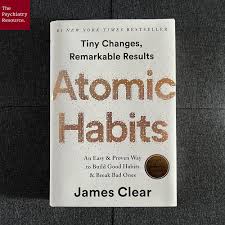
Atomic Habits by James Clear is built on one powerful idea: you do not rise to the level of your goals, you fall to the level of your systems. In other words, the outcomes you want are not the result of occasional bursts of motivation, but of the small, repeatable processes you follow every day. This summary walks through the book's key lessons, the famous four laws of behaviour change, and the deeper ideas about identity that make it so effective, along with why it is worth owning a copy rather than relying on a summary alone.
The 1% rule and the power of compounding
James Clear opens with a striking piece of maths. Getting just one percent better every day leads to results that are nearly 37 times better over a single year, because tiny gains compound. The flip side is just as important. One percent worse each day grinds you down to almost nothing over the same period. Habits are the compound interest of self-improvement, and like compound interest, their effects are invisible at first and dramatic later.
This is why most people give up. They make a small change, see no immediate result, and conclude it is not working. Clear calls this the plateau of latent potential, the long flat stretch where progress is building but not yet visible. The lesson is to trust the process and keep showing up, because the breakthrough almost always arrives later than you expect.
Identity-based habits
Perhaps the most important idea in the book is that lasting change is identity-based, not outcome-based. Instead of focusing on what you want to achieve, focus on who you want to become. The goal is not to read a book, it is to become a reader. The goal is not to run a marathon, it is to become a runner. Every action you take is a vote for the type of person you wish to be, and habits are how you cast those votes daily until your self-image shifts to match them.
The four laws of behaviour change
The practical core of the book is a simple four-step loop, cue, craving, response and reward, and a corresponding set of four laws for building any good habit. To break a bad habit, you simply invert each law.
- Make it obvious: design your environment so good habits are easy to notice. Use cues, implementation intentions and habit stacking so the right behaviour is the natural next step.
- Make it attractive: pair habits with things you enjoy, and surround yourself with people for whom your desired behaviour is normal, so the craving works in your favour.
- Make it easy: reduce friction and start with a two-minute version of the habit, because a habit you can do consistently beats an ambitious one you abandon.
- Make it satisfying: reward yourself so the habit sticks, and track your progress so you can see the streak you do not want to break.
To break a bad habit, you reverse the laws. Make it invisible by removing the cue, make it unattractive by reframing it, make it difficult by adding friction, and make it unsatisfying by adding a cost. This simple framework can be applied to almost any behaviour you want to change.
Key takeaways you can apply today
Three practical ideas stand out for immediate use. First, the two-minute rule, which says to scale any new habit down to something you can do in two minutes, so that starting is effortless. Second, habit stacking, where you attach a new habit to an existing one, such as meditating right after your morning coffee. Third, environment design, since changing your surroundings is often easier and more reliable than relying on willpower. Put the book on your pillow and you will read at night. Keep your phone in another room and you will scroll less.
A worked example: building a reading habit
Say you want to read more. Applying the four laws looks like this. Make it obvious by leaving a book on your pillow each morning so you see it at night. Make it attractive by choosing a book you genuinely want to read rather than one you think you should. Make it easy by committing to just one page, the two-minute version, so there is no excuse to skip. Make it satisfying by ticking off each day on a simple calendar so the streak itself becomes a reward.
Notice that none of this depends on motivation. The system carries you on the days you do not feel like it, which is the whole point. Most people quit habits on the hard days, so the goal is to design those days to be as frictionless as possible. This single example can be adapted to exercise, journaling, saving money, or any behaviour you want to make automatic.
Who should read Atomic Habits
This book is for anyone who has set a goal, started strong, and then watched the habit fade after a few weeks, which is to say almost everyone. It is especially valuable for students, professionals and anyone in their 20s who is setting the routines that will shape the next decade. If you have tried and failed to stick with a habit before, the problem was almost certainly your system, not your willpower, and that is exactly what this book fixes.
Why read the full book
A summary gives you the map, but the real value of Atomic Habits is in the stories, examples and exercises that show you exactly how to apply each idea to your own life. Reading the full book changes the way you see your daily routine in a way a summary simply cannot. Grab a copy on TheBookX, and pair it with The Art of Clarity by Murthy Thevar to sharpen the thinking behind your habits, or with The Art of Not Overthinking to protect your consistency when motivation dips.
The bottom line
Atomic Habits endures because its core idea is both simple and true, that your results are the sum of your systems, and your systems are built one tiny habit at a time. Master the four laws, anchor them to the identity you want, and trust the compounding even when progress feels invisible. A summary like this one is a useful refresher, but the full book is where the change actually happens. Read it, apply one law this week, and pair it with The Art of Clarity to make sure the habits you build are the ones that genuinely matter.